Showing posts sorted by relevance for query Google. Sort by date Show all posts

Wednesday, January 3, 2007

Rich Skrenta: Google won already

by Anders Bylund

Computer industry heavyweight Rich Skrenta thinks that Google has essentially won the online search and advertising war, and that the entire Internet is Google's to enjoy, direct, and profit from. Does he mean "won" in the sense of Athens at the battle of Marathon, or how the Iraqi information minister used it? Let's have a closer look.

Skrenta, who played instrumental parts in Netscape's search strategy, building the Open Directory, and developing the Amiga Unix OS, bases his claim on Google's technological lead and, in turn, the massive mindshare the company has built up over the years. He cites a study reporting that users looking at Google search results under a Yahoo logo are inclined to think the results less relevant, and vice versa. Following this, he argues, it doesn't really matter if Ask or Microsoft can beat Google at the search game, because it has already won that battle in the hearts and minds of consumers.

And what follows from Google's position at the center of the 'Net is a massive monetizing opportunity—which Google nailed down as well. The AdSense program is undeniably successful, though Skrenta may overstate its position. He claims that "Google's CPMs are $90-120, vs. $4-5 for an average browse page view elsewhere." We're somewhat suspicious of those figures here at the Orbiting HQ, and they may be his own best guess based on ad revenues at his own sites.

Skrenta keeps repeating his pithy mantra, "Google is not your competition, Google is the environment." He then says that Yahoo, for example, should follow the lead of Ask.com and surrender to the Google money machine. By his calculations, the Y is leaving $1.7 billion of annual revenue on the table by trying to run its own advertising network rather than letting AdSense/AdWords run the show.

By making advertising partners out of even potential competitors, and backing the whole thing up with arguably the best search engine available (though you may have other favorites), the Mountain View online Brobdingnagian has cemented its place as the central point of the Internet, the one place where all the buyers and the vendors, the readers and the publishers, meet up to conduct their business. To beat Google now, somebody would have to come up with a better search and a better advertising solution, and then convince the general public and the business world, respectively, of these feats.

It sounds daunting indeed, and Mr. Skrenta makes sense on many levels. I use and like a lot of Google's products every day. The company has plans to grow beyond the invisible borders of the online world pretty soon, starting with some tentative radio and print advertising programs. Call it the world's librarian, making a few pennies off every piece of information we all consume. Still, no victory is everlasting. We'll just have to see how long Google can sit on this throne. 10 years on the 'Net is epoch. Will Google still be the leader 10 years from now?

(c) www.arstechnica.com

Saturday, March 17, 2007

Google to Develop a Short Term Memory

by Marcus Yam

Google to make search logs anonymous after 18 to 24 months

Google

Google is changing its policies on storing information about its users. Each time a user conducts a search on Google, a database logs his or her keyword search, IP address and certain other bits of data stored in cookies. Currently, this information is stored indefinitely, but the new policy, which Google plans to implement over the next few months, will make the data slightly more anonymous to protect the privacy of its users.

“Previously, we kept this data for as long as it was useful,” Google officials said in statement. “Unless we're legally required to retain log data for longer, we will anonymize our server logs after a limited period of time.”

Google says it will remove the last eight bits of a user’s IP address 18 months to 24 months following the initial recording of information. All the bits before it, however, will remain intact and may still give authorities good indication on the original user. Even with the last eight bits of an IP address unknown, it is still possible to determine the approximate location and internet service provider of the user.

“Logs anonymization does not guarantee that the government will not be able to identify a specific computer or user, but it does add another layer of privacy protection to our users' data,” Google said to the media.

The U.S. government has been putting pressure on search companies to keep records of user activities in an effort to maintain national security. Privacy advocates, on the other hand, are pushing in the opposite direction and lobby for companies such as Google to maintain no records at all.

“By anonymizing our server logs after 18-24 months, we think we're striking the right balance between two goals: continuing to improve Google's services for you, while providing more transparency and certainty about our retention practices,” the Google statement said.

(c) www.dailytech.com

Uni.Technology Tags: ,

Saturday, December 30, 2006

Google v. Technorati (and Hitwise v. Comscore)

by Michael Arrington

Google v. Technorati (and Hitwise v. Comscore)Metrics company Hitwise writes a sensational blog post showing the dramatic rise of Google Blog Search against competitors Technorati and Sphere. Their data is saying that this week, for the first time, Google Blogsearch surpassed Technorati in total visits.
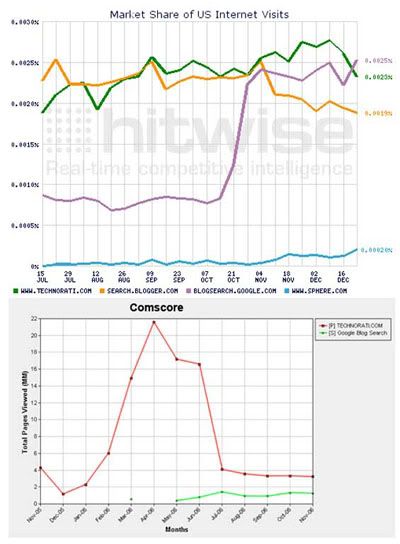
Google Blog Search just passed 0.0025% of total internet traffic, according to Hitwise, v. 0.0023% for Technorati. The reason for the surge seems pretty straightforward: Google linked their Blog Search product to Google News in October, which had a immediate and significant impact on traffic. Google also added a Blog Search link in the “More” section on the Google main page. It was not enough to take the lead, but a recent Technorati decline in traffic put Blog Search on top.

It makes sense that the extra attention Google is giving BlogSearch would result in a spike in traffic, but we looked to Comscore for confirmation. What a surprise.

Comscore tells a much different story, and one that makes little sense given the facts. The most recent Comscore data (November) says Technorati had 3 million page views v. Google Blog Search’s 1 million. But Comscore also shows highly erratic Technorati data over the last twelve months, swinging from a high of 22 million page views in April 2006 to a low of 1 million in December 2005.

We’ve seen situations where Comscore showed erratic traffic swings before. In August Comscore showed a significant decline in Del.icio.us traffic, when Hitwise said it was increasing. Yahoo showed disclosed some internal traffic stats and it turned out Comscore was dead wrong. In the case of Technorati v. Google, it looks to be wrong again.Google v. Technorati (and Hitwise v. Comscore)

(c) www.techcrunch.com

Friday, December 15, 2006

Google Starts Selling Domains For $10 Per Year

Google's logo

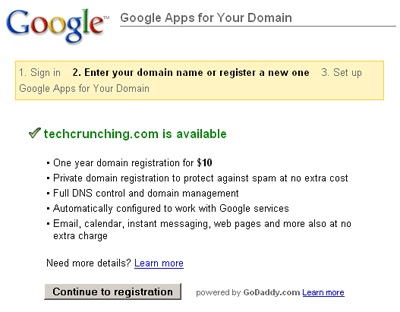
Google has entered the domain business with partners GoDaddy and eNom. An already crowded industry, Google has begun allowing people to register ‘.com’, ‘.net’, ‘.biz’, and ‘.info’ Web site addresses. Web sites that register their domains directly with Google for $10/year will automatically be setup to use Google Apps for Your Domain, which includes Google’s Page Creator (for easily making a Web site), Calendar, Email, and IM.
With this move, look for Google to tap more into the domain parking business using their Google AdSense for Domains product a bit more. I’d also imagine their Blogger product will integrate this announcement and allow you to easily setup a blog with your own domain for $10/year.Google Starts Selling Domains For $10 Per Year

[original post: www.techcrunch.com]

Saturday, December 30, 2006

Google Top Searches: Based on Everything and Nothing

by Michael Arrington

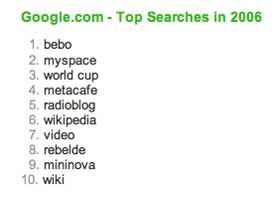
Google Top Searches: Based on Everything and NothingGoogle made a clarification today to their much criticized list of most popular queries in their search engine. The list raised eyebrows because it included some fairly unlikely terms. “Bebo” for example, was the number one term on the list.

In the original announcement, Google said: “Google today announced its annual Zeitgeist, featuring lists and charts of the most popular and fastest-rising global search terms that people have typed into Google.com.” It turns out that while that statement was literally accurate, it was still somewhat misleading.

Google Top Searches: Based on Everything and NothingIn the clarification today, Google said: “we do not simply retrieve the most frequently-searched terms for the period — the truth is, they don’t change that much from year to year…Instead, we looked for those searches that were very popular in 2006 but were not as popular in 2005 — the explosive queries, the topics that everyone obsessed over. To come up with this list, we looked at several thousand of 2006’s most popular searches, and ranked them based on how much their popularity increased compared to 2005. (”Bebo”, for example, had very little traffic in 2005.) We also gave a bit higher score to searches with more traffic. Similarly, our “what is” and “who is” lists are not necessarily the absolute most frequent searches, but rather those that best represent the passing year.”

I agree with Liz Gannes at GigaOm. If at the end of the day Google is taking the top few thousand searches, subjectively picking a handful that are interesting and then redetermining the order based on velocity of growth rather than overall rankings, we end up with a list that is, in the end, completely meaningless.

(c) www.techcrunch.com

Wednesday, January 3, 2007

Google Misses YouTube Anti-Piracy Deadline

Google Misses YouTube Anti-Piracy Deadline

Google rings in the new year without its promised anti-piracy protection scheme

Although YouTube rang in 2007 with a virtual New Year's Eve festival complete with a performance from Warner Music, live performances and participation from hordes of online members, the company failed to meet its self-imposed deadline to implement anti-piracy protection on its site. In an agreement with Warner Music Group, YouTube promised in September to have an anti-piracy system in place that would feature an "advanced content identification and royalty reporting system."

The anti-piracy system to be in place by the end of 2006 was a part of a deal which allowed Google to distribute Warner music videos, artist interviews and other music-related content. When Google acquired YouTube for $1.65 billion USD in October, it was widely expected that Google's deeper pockets would give YouTube the financial backing to implement such anti-piracy measures.

Missing the year-end deadline could be seen as a virtual pothole on the road to a more controlled distribution channel, but YouTube still can save face by getting the system live within the opening weeks of 2007. "It is hugely important, especially from the rights holders' perspective, that the best efforts are being made to corral the stuff flowing through YouTube," said Michael McGuire of Gartner Research. "Rights holders are making specific bets on paths of distribution and are expecting serious effort to make uncontrolled distribution difficult for most folks to do."

For now, YouTube is leaving the ball in the user's court when it comes to copyrighted music by telling users that uploading content "shall be at your sole risk."

(c) www.dailytech.com

Saturday, December 30, 2006

Gmail Disaster: Reports Of Mass Email Deletions

by Michael Arrington

Gmail Disaster: Reports Of Mass Email DeletionsJust a week after I wrote “Uh Oh, Gmail Just Got Perfect” a number of users started complaining that all of their Gmail emails and contacts were auto deleted.

The first message, posted on the Google Groups forum on December 19, stated “Found my account clean..nothing in Inbox, contacts ,sent mail..How can all these information residing in different folders disappear? ..How to write to gmail help team to restore the account..is it possible?..Where to report this abuse?.Any help ..Welcome..Thanks in advance ps101″

Other Gmail users then added to the conversation, saying that their emails had been deleted as well. Most of the users reported using Firefox 2.0 and that Gmail was open in their browser when the deletions occured.

The cause of the problem isn’t clear. One user wrote that after the deletion they received the following message: “This is not a mistake. All your emails and contacts have been deleted on purpose. This was a malicious attack and not an error. Have a nice day. =)” One user pointed to a known security issue with Firefox 2.0, which was fixed in 2.0.0.1.

On December 22, four days after the initial incident was reported, a Google representative posted this message on the thread:

Thank you all for reporting this issue. We apologize for the scare and
inconvenience that it’s causing. We’re actively investigating as we
speak, and we’ll follow up individually with users in this thread as we
get to the bottom of the problem.

We appreciate your patience and understanding.

Google’s official policy is that once emails are deleted, they are gone forever. And based on the Google Groups thread, no one has been able to have their Gmail accounts restored to pre-deletion status.

Update: A representative from Google just sent the following email:

Hi there TechCrunch folks,

We saw your post today about Gmail and wanted to let you know what was going on.

Regretfully, a small number of our users — around 60 — lost some or all of their email received prior to December 18th. Once we found out about this issue, we worked day and night to confirm that only a few accounts were affected and to do whatever we could to restore as much of the users’ accounts as we could. We’ve also reached out to the people who were affected to apologize and to work with them to restore the email from any personal backup they might have.

We know how important Gmail is to our users – we use it ourselves for our corporate email. We have extensive safeguards in place to protect email stored with Gmail and we are confident that this is a small and isolated incident.

Thanks,
Courtney

(c) www.techcrunch.com

Tuesday, December 26, 2006

Send Greetings, The Google Earth Way

Send Greetings, The Google Earth Way

Send greetings this holiday season to your friends and family, the Google Earth way using geoGreeting.

Spell out your message using rare alphabet shaped building found on earth, snapped by Google Earth. Head over to geoGreeting.com, type your message and email the link to your friends and make them happy.

(c) www.tech-buzz.net

Sunday, December 24, 2006

Wikipedia-based Search Engine: Exclusive Screenshot

by Michael Arrington

The Times reported earlier today that Wikipedia founder Jimmy Wales is planning to launch a new search engine next year, to be called Wikiasari.

He’s clearly aiming for Google. He says:

“Google is very good at many types of search, but in many instances it produces nothing but spam and useless crap. Try searching for the term ‘Tampa hotels’, for example, and you will not get any useful results…Essentially, if you consider one of the basic tasks of a search engine, it is to make a decision: ‘this page is good, this page sucks.’ Computers are notoriously bad at making such judgments, so algorithmic search has to go about it in a roundabout way…But we have a really great method for doing that ourselves. We just look at the page. It usually only takes a second to figure out if the page is good, so the key here is building a community of trust that can do that.”

The new company will be the third business division of Wikia, the for profit company that Wales founded in 2005 and is now led by CEO Gil Penchina. The other two business units are the main Wikia wiki site itself, and the recently launched OpenServing product.

Wikia has raised over $4 million in capital, including a recent round by Amazon.

Despite the fact that the original article reported that Amazon is involved in the project, Wikia is making it clear on the site that they are not invovled in any way (other than as a shareholder of Wikia).

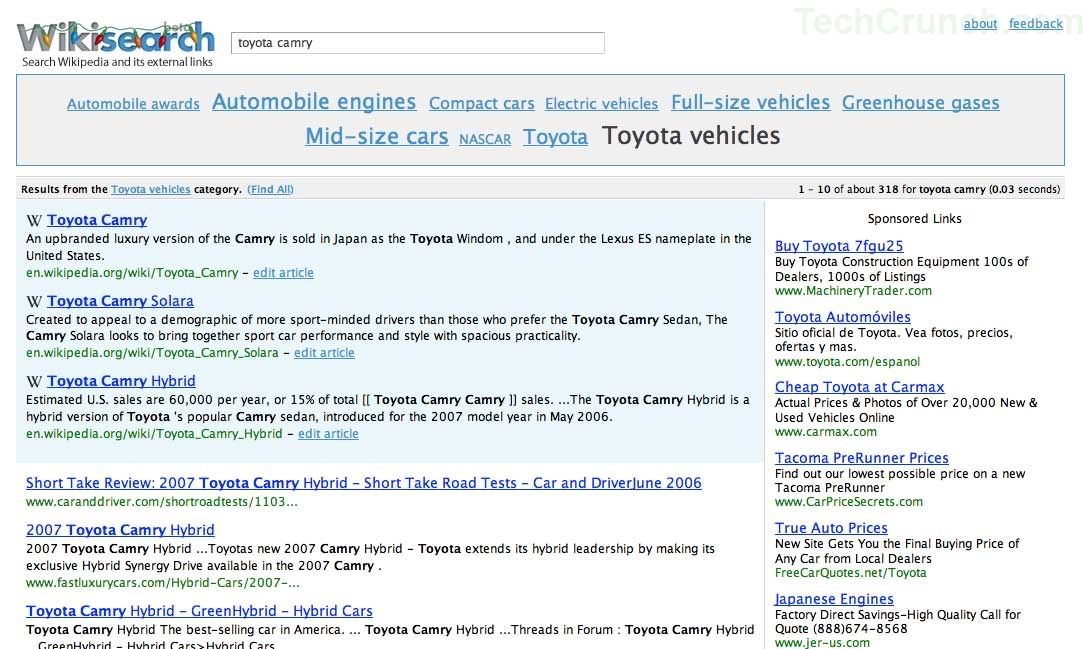
Wikiasari  Wikipedia-based Search Engine: Exclusive Screenshot

A source tells us that the working name for the project was “WikiSearch” until recently. It’s clear that Wikiasari will be focused on quality first, depth second. Search results will include tag based navigation, the top three results will be wikipedia content, and the remaining results are determined by sites wikipedia considers to be “reputable” because they are external reference links from wikipedia pages.

Since all search results will be tied to wikipedia, either directly by linking to wikipedia content or because the sites are linked to from Wikipedia, real people will eventually be determining all search results and rankings within Wikiasari. The search engine will be opensource, and the index will be available under a GFDL. Wikia will operate the master version of the index, but others are free to take it under the terms of the GFDL.

The engine itself will be built on the Nutch and Lucene open source projects.

Wikiasari will be a for profit venture, although the “majority” of proceeds will be donated to Wikipedia.

We obtained the screenshot from a trusted source outside of Wikipedia - we can’t guarantee it’s not a fake but our belief is that this is a genuine working screenshot of the application. Click on it to see full size version.

(c) www.techcrunch.com

Saturday, December 30, 2006

Japanese Media Still Unhappy with YouTube

 by Geoff Duncan

Japanese Media Still Unhappy with YouTubeJapanese media groups have called YouTube's response to copyright violations "unsatisfactory," but are still hopeful things can be worked out.

Just after its acquisition by Internet titan Google, popular video sharing Web site YouTube pulled down nearly 30,000 Japanese video files from its service in response to complaints from JASRAC, the Japan Society for Rights of Authors, Composers and Publishers. However, Japanese publishers are far from happy with YouTube's efforts to remove copyright violations from its service, characterizing the company's response as "unsatisfactory." However, publishers are still hopeful a solution can be reached without litigation.

On December 4, JASRAC outlined a series of of preventive measures it would like to see taken to deter copyright infringements on YouTube until a comprehensive system can be put into place. JASRAC asked for Japanese-language notices on the YouTube site warning that copyright violations are illegal, that YouTube collect names and addresses of users uploading video material to the site, and that YouTube terminate accounts of users who post copyrighted material. JASRAC sets a deadline of December 15, 2006…which came want went with only a brief reply from YouTube's Chad Hurley and Steve Chen.

In their response, YouTube said they're working on Japanese-language versions of their copyright warnings, and has been terminating accounts of users who repeatedly violate their terms of service. YouTube also offered a simplified version of tool enabling publishers to request take-down of infringing material. However, YouTube noted that it does not currently require any sort of user authentication but would "strive for improvement"—but offered no concrete information or timetable. YouTube also indicated it wanted its senior staff to meet with Japanese publishers in regard to business development in Japan.

(c) www.digitaltrends.com

Monday, December 18, 2006

Facebook Would Like To Remind You It Isn't For Sale (Wink Wink), But Is Now Worth $8 Billion

It was reported earlier this week that Yahoo was prepared to shell out up to $1.62 billion to buy Facebook, based on the inflated expectation that it could generate a billion-dollar profit by 2015. Apparently Yahoo's offer of $1 billion to Facebook got rejected, and the company never got another chance to bid. While most rational people would have taken the money and ran, Facebook now says it's no longer for sale, with a board member saying they want to build the company up. We'd like to again take this opportunity to point Facebook to the history of Friendster, which is the classic example of not knowing when to sell out -- the company was being shopped around for $5 million earlier this year, after Google had offered to buy it for $30 million worth of pre-IPO stock in late 2003, and a price of $200 million was mentioned for it in 2005. But, true to form, Facebook is following the Skype billion-dollar buyout plan (most recently enlisted by YouTube): a board member says that the company isn't for sale... but that it's worth $8 billion -- as much as that fly-by-night youth-oriented business MTV. Clearly the Skype blowout buyout business model is seeing the effects of inflation (otherwise known as a bubble), which is mildly amusing given talk that Skype is having some trouble meeting the targets to trigger the $1.5 billion earnout that was on top of the $2.6 billion eBay paid for it in cash and stock. Getting the cash up front, then running as far and as fast as you can, really seems like the best play for these companies.

[Thanks goes to  www.techdirt.com for this article]

Tag Cloud